Luzon
Metro Manila Map
Introduction

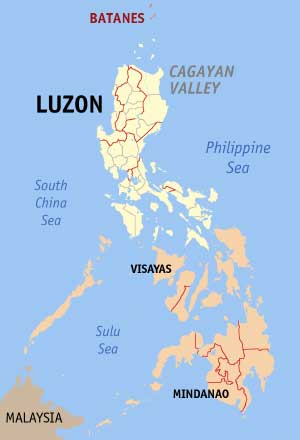
Luzon (pop. 41,445,652) is the largest, most populated, and a politically important island area of the Philippines. More than half the country's people live in Luzon. It is one of the three major island groups in the country, (the other two being Visayas and Mindanao) and is found in the north. The island covers an area of 40,420 square miles (104,688 square kilometers), more than one-third of the entire land area of the Philippines. Luzon is the site of Manila, the nation's capital and major metropolis, and of Quezon City.

Geography
Luzon as an island group includes the island of Luzon itself, plus the northern Batanes and Babuyan groups of islands, and the main and outlying islands of Cantanduanes, Marinduque, Masbate, Romblon, and Mindoro in the south. The island group of Palawan used to belong to the region of Luzon and was transferred to Visayas in 2005.

Mountains extend across the island, from the Bicol peninsula to the southeast, the site of the famous Mt. Mayon, and the Cordillera range in the north, from which rises Mt. Pinatubo. The western Zambales range runs from Lingayen Gulf south to Bataan peninsula. The island has two large lakes, Laguna de Bay and Taal, the latter which contains a small volcano in itself.

People
Inhabitants of Luzon are almost all Christian and are mostly Tagalogs and Ilocanos. Indigenous peoples include the Negritos and Igorots (the latter's famous rice terraces on steep mountain slopes are considered one of the agricultural wonders of the world).

Agriculture and Industry
Luzon is the nation's major rice-producing region and is the second sugarcane-producing area (after Negros island). The Bicol peninsula is known for its coconut plantations; the Cagayan River valley for its tobacco and corn. Other major crops are fruits, vegetables, and cacao; mining and lumber materials include gold, chromite, nickel, copper, iron deposits and bamboo. Manila industries produce textiles, chemicals, and metal products.
           
History
Luzon has been the site of many historical battles and moments such as the Filipino revolt against Spanish rule (1896), U.S. forces taking control of the islands from Spain (1898), the Philippine uprising against U.S. rule (1899), invasion by Japanese forces (1941), and the Allied Forces’ last stand (1942) on Bataan peninsula and Corregidor. Luzon was recovered in 1945 after a major struggle. Luzon's U.S. military bases were closed down between 1971 and 1992, partly because of the devastation caused by Mt. Pinatubo's eruption in 1991.